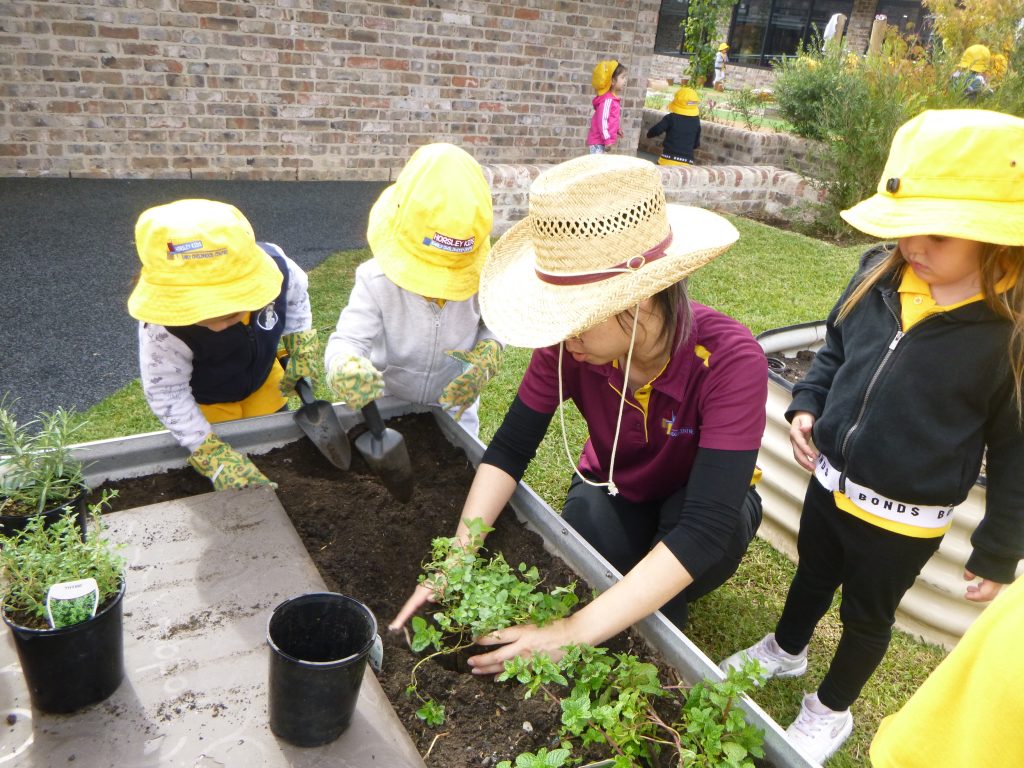
What is the Reggio Emilia approach — and why are western Sydney families choosing it for their children?
April 6th, 2026
If you have been researching early learning centres in western Sydney, you have probably come across the term Reggio Emilia. It appears on websites, in brochures, and in conversations between parents at school gates. But what does it actually mean — and more importantly, what does it look like for your child?
This article explains the Reggio Emilia philosophy in plain language, what it looks like in practice at an early learning centre, and why it resonates so deeply with families across Horsley Park, Wetherill Park, Fairfield and the surrounding suburbs.
Where did the Reggio Emilia approach come from?
The Reggio Emilia approach was developed in the town of Reggio Emilia in northern Italy in the years following World War Two. Led by educator Loris Malaguzzi, communities in the region began rebuilding their schools with a radical idea at the centre: that children are not empty vessels waiting to be filled with knowledge. They are capable, curious, and deeply motivated to understand the world around them.
Malaguzzi described children as having one hundred languages — one hundred ways of thinking, expressing, and making sense of their experiences. Drawing, painting, building, dancing, storytelling, conversation, music — each is a legitimate form of intelligence and communication. The Reggio Emilia approach honours all of them.
Over the decades, this philosophy spread from a small Italian town to early learning centres across the world. Today it is widely regarded as one of the most thoughtful and effective approaches to early childhood education in existence. You can read more about the origins of the approach at Reggio Children.
What makes it different from a traditional childcare program?
In a traditional early childhood program, the educator plans the day. Activities are set, topics are chosen in advance, and children move through a predetermined schedule.
In a Reggio Emilia inspired program, the child leads. Educators observe carefully — watching what captures a child’s attention, listening to the questions they ask, noticing what they return to again and again. From these observations, educators plan experiences that extend and deepen each child’s natural curiosity.
This is called an emergent curriculum, and it looks different every day because every group of children is different every day.
It also means that when a child is absorbed in something — a painting, a construction project, an investigation into why leaves change colour — that work is respected and left in place. Nothing is packed away mid-discovery. Children move through their day with intention and continuity, not interruption.
What does it actually look like at Horsley Kids?
At Horsley Kids, the Reggio Emilia philosophy is embedded in every part of the day — not just during designated activity time.
Educators observe and document constantly. You will see them taking photographs, writing notes, recording conversations. This documentation is not administrative — it is the foundation of the curriculum. It tells educators what a child is ready to explore next, what relationships they are building, and what skills they are developing.
The environment itself is treated as a teacher. Each classroom at Horsley Kids is a carefully curated space — filled with natural materials, open-ended resources, art supplies, books, and areas for individual, small group, and large group activity. The layout invites exploration and allows children to make choices about where they go and what they do.
Projects grow from genuine interest. A group of children might become fascinated with the native stingless bees that live in the garden at Horsley Kids. That curiosity becomes an investigation — into pollination, into bee habitats, into Aboriginal bush tucker traditions, into the role of insects in our ecosystem. The project unfolds over days or weeks, deepening as the children’s questions lead them further.
At the end of each year, every child receives a personalised portfolio — a collection of photographs, artwork, observations, and written documentation that captures their unique learning journey. You can read more about our program and curriculum to see how this comes to life across the centre.
Why does it matter for school readiness?
One of the most common questions parents ask is whether a play-based, child-led approach actually prepares children for the structure of primary school.
The answer is yes — and research consistently supports it.
The skills that predict success in kindergarten and beyond are not academic ones. They are social and emotional: the ability to manage feelings, to collaborate with others, to persist when something is difficult, to ask for help, to listen, to communicate. These are precisely the skills that a Reggio Emilia inspired environment builds — every day, through every experience.
The Early Years Learning Framework underpins this approach at a national level, recognising that children learn best through play, relationships, and environments that respect their individuality. Children who have been encouraged to direct their own learning, to ask questions, to investigate and reflect, arrive at school with something more valuable than a head start in reading and writing. They arrive with a genuine love of learning. And that is something that lasts a lifetime.
Why do western Sydney families choose Reggio Emilia inspired childcare?
Western Sydney is one of the most culturally diverse regions in Australia. Families here come from dozens of different backgrounds, speak different languages at home, and hold a wide range of values and traditions.
The Reggio Emilia philosophy is built on respect — for each child’s individuality, for the knowledge and culture families bring, and for the community as a whole. It does not impose a single way of being or learning. It makes space for every child to be exactly who they are.
At Horsley Kids, educators and children represent more than 15 cultures. The multilingual team, the culturally diverse menu, and the inclusive curriculum all reflect the community the centre serves. The Reggio Emilia approach provides the philosophical foundation that makes all of this possible — because when you genuinely believe every child is capable and full of potential, you look for that potential everywhere. You can read more about our philosophy and the values that guide everything we do.
Is Reggio Emilia right for your child?
If you are looking for an early learning centre where your child will be known — not just by name, but deeply known — where their interests will shape what they learn and their voice will be genuinely heard, a Reggio Emilia inspired environment may be exactly what you are looking for.
At Horsley Kids, we have been guided by this philosophy since we opened our doors in 2005. It informs how we design our classrooms, how we plan our curriculum, how we talk with children, and how we partner with families.
We would love to show you what it looks like in person. Book a tour of our purpose-built centre on The Horsley Drive and see the Reggio Emilia approach in action.